Self-checkout payback calculator

Work out how quickly self-checkout pays for itself in your store, using current Australian award rates and an allowance for the extra shrink that self-checkout brings. Two self-checkouts typically pay back within 18 to 24 months if a store removes about three rostered register hours a day.


Payback calculator

Work out your store’s payback

Pick the set-up closest to yours, then enter your own roster, sales and quote. The calculator uses current Australian award rates and deducts the extra shrink that self-checkout brings. Every number can be changed.

Two self-checkouts typically pay back within 18 to 24 months if your store removes about three rostered register hours a day.

Your store

$
hrs
$
%
Pay rates and trading hours

Casual Level 1 rates, General Retail Industry Award, from 1 July 2026. Hours are per register, per week.

$
$
$
$
hrs
hrs
hrs
hrs
%
%

Estimated net saving

$1,426a week

Add your quoted price per unit to see your payback month and break-even hours.

Request a quote

Your savings, month by month

Each bar is the running total of net savings. Add your quote to see when the investment is paid back.

Saving

Indicative estimates only, not financial advice. Results depend on the hours your store actually removes from its roster. Pay rates are adult casual Level 1 minimums under the General Retail Industry Award 2020 (MA000004) from 1 July 2026, plus superannuation and workers’ compensation; payroll tax and public holidays are excluded. See how the calculation works

Video

The payback, explained in two minutes

How one register position is costed, why shrink is deducted, and what three typical store set-ups save.

Worked examples

Three typical store set-ups

Each counts labour saved at current award rates, less 4% extra shrink on self-checkout sales. Divide your own quote by the weekly saving to see your payback.

Most smaller stores

Second register opens at peak times

Two self-checkouts replace the register opened at busy times, about 45 rostered hours a week.

$1,426 a week

Net saving, about $74,100 a year

Busier smaller stores

Second register staffed all day

Two self-checkouts replace one register position, about 90 rostered hours a week.

$3,378 a week

Net saving, about $175,700 a year

Larger stores only

Five self-checkouts, one team member

Five self-checkouts replace four registers staffed all trading hours, about 360 hours a week.

$13,566 a week

Net saving, about $705,400 a year

Method

How the calculation works

  1. Labour saved. Rostered register hours removed each week, multiplied by $43.38 an hour: the weighted casual Level 1 award rate of $38.16, plus 12% superannuation and 1.5% workers’ compensation.
  2. Less extra shrink. 2026 industry research found each extra 1% of sales through self-checkout adds about 0.03 to 0.05 points of store shrink, equal to 3% to 5% of self-checkout sales. We deduct 4% by default.
  3. Payback. Your investment divided by the net saving each week.

Payback (weeks) = Your investment ÷ (Labour saved per week − Extra shrink per week)

The calculation is deliberately conservative. It counts labour savings only, gives no credit for extra sales, values shrink at retail price and leaves out payroll tax. Savings only count when hours come off the roster; hours a team member spends on other duties add capacity, not savings.

Assumptions

AssumptionValue used
AwardGeneral Retail Industry Award 2020 (MA000004), Retail Employee Level 1, adult casual, from 1 July 2026
Weekday, before 6pm$34.76 an hour
Weekday after 6pm, and Saturday$41.72 an hour
Sunday$48.67 an hour
Trading hours per register90 a week: Mon to Fri 7am to 9pm, Sat 7am to 6pm, Sun 9am to 6pm
On-costs12% superannuation, 1.5% workers’ compensation (varies by state)
Extra shrink4% of self-checkout sales
Self-checkout sales$1,880 a day for two units, from published Australian independent grocery pilots

Sources: General Retail Industry Award pay rates 2026/27; ECR Retail Loss self-checkout findings, 2026. Every assumption can be changed in the calculator above.

Throughput

Two lanes, one team member

Two EM SCO-F lanes overseen by one team member can handle about 80 to 120 transactions an hour, compared with 40 to 60 at a single staffed register. The gain comes from lanes working side by side, not faster scanning: per item, customers scan more slowly than a trained cashier.

80 to 120transactions an hour, two EM SCO-F lanes
40 to 60transactions an hour, one staffed register

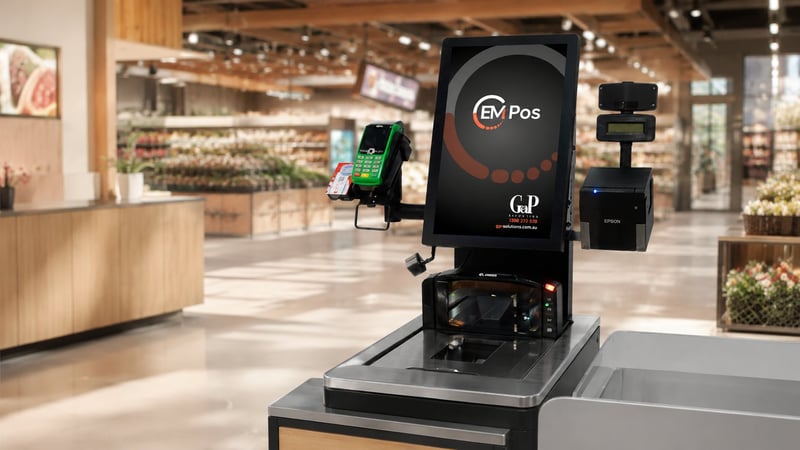
EM SCO-F

EM SCO-F in store

A full self-checkout with AI product recognition, an 18.5 or 21.5 inch touchscreen and EM Cloud™ pricing on every lane.
Talk to us about your store’s numbers

We’ll work through your roster, front-end layout and quote with you, and show you EM SCO-F in action.

Frequently asked questions

How long does self-checkout take to pay back in Australia?

Two self-checkouts typically pay back within 18 to 24 months if a store removes about three rostered register hours a day. Stores that take a peak-time or all-day register off the roster can pay back much sooner. The calculator on this page works it out for your own roster and quote.

What does a register hour cost under the retail award?

About $43.38 an hour for an adult casual Retail Employee Level 1 from 1 July 2026. That is the General Retail Industry Award rate weighted across weekday, evening, Saturday and Sunday hours ($38.16), plus 12% superannuation and 1.5% workers’ compensation.

Does self-checkout increase shrink?

Yes. 2026 industry research found each extra 1% of sales through self-checkout adds about 0.03 to 0.05 points of store shrink, which equals 3% to 5% of self-checkout sales. The calculator deducts 4% by default. AI product recognition on EM SCO-F helps reduce produce miscoding and missed scans.

How many transactions can two self-checkouts handle?

Two EM SCO-F lanes overseen by one team member can handle about 80 to 120 transactions an hour, compared with 40 to 60 at a single staffed register. The gain comes from lanes working side by side, not faster scanning.

What does the calculator leave out?

It counts labour savings only. It gives no credit for extra sales, and excludes payroll tax and public holiday rates. Savings only count when hours come off the roster; hours moved to other duties add capacity, not savings.